
Concrete Steps Des Moines
Old, broken steps at your front door tell visitors something you probably do not want them to know. Colin Concrete Des Moines builds concrete steps and stair systems that look sharp, pass inspection, and hold up through years of Iowa weather.
Thank you for reading this post, don't forget to subscribe!The Real Reason Concrete Steps in Des Moines Fall Apart
Concrete steps near the entry of a home or business take on a particular kind of stress that flat surfaces like patios and driveways do not. Water does not just sit on top — it runs off the treads, pools against the riser faces, and works its way into any gap between the step unit and the adjacent wall. In an Iowa winter, that moisture freezes, expands, and starts wedging the structure apart from within.
Structural cracking in step systems almost always originates at two points: the tread-riser joint where water collects in the corner, and the back edge where the steps meet the house or foundation wall. Once a crack opens at either location, winter moisture has a direct path into the interior of the concrete mass. The damage compounds from that point forward with each passing season.
What makes the problem worse is that most failing steps in Des Moines were not built with adequate base support to begin with. Steps placed directly on native soil settle unevenly as the ground shifts. One side drops, the step tilts, the joint at the house opens up, and suddenly a cosmetic concern has become a structural one that affects how people enter and exit the building every day.
Colin Concrete Des Moines builds concrete steps from the ground up — base preparation included — so the finished installation performs correctly from year one through year twenty-five.
Concrete Step Installation in Des Moines — How It Is Done Right
Good step installation is about three things done in the right order: solid ground preparation, accurate forming, and a concrete mix that can handle outdoor exposure in a climate like Iowa's.
Ground preparation begins with removing whatever is already there — existing failed steps, debris, and any soft or organic material underneath. The excavated area is filled with compacted granular material that drains freely and does not compress under load over time. This base layer is what keeps the finished steps from settling or rocking after the pour.
Forms are built to the exact riser height and tread depth dimensions required by code. Every riser in the flight must match — variation of even half an inch across a short stairway is enough to create an inconsistent step rhythm that causes people to stumble. The form work is checked for level and squareness before any concrete is ordered.
The pour uses a mix with a low water-to-cement ratio, which produces denser, less permeable concrete that resists surface scaling from Iowa road salt and freeze-thaw cycling. After placement, tread surfaces are finished with a light texture for grip and edges are tooled to shed water efficiently.
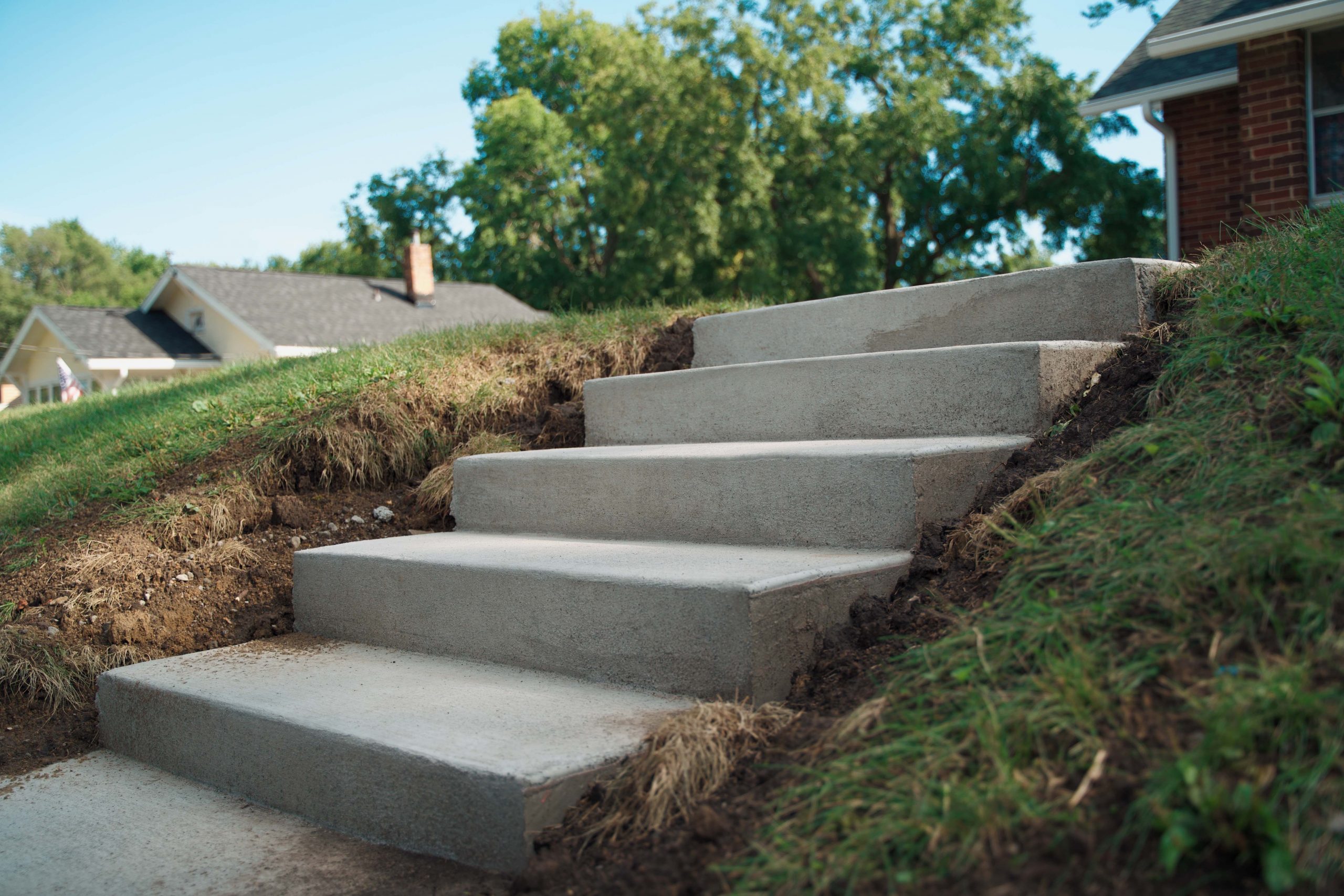
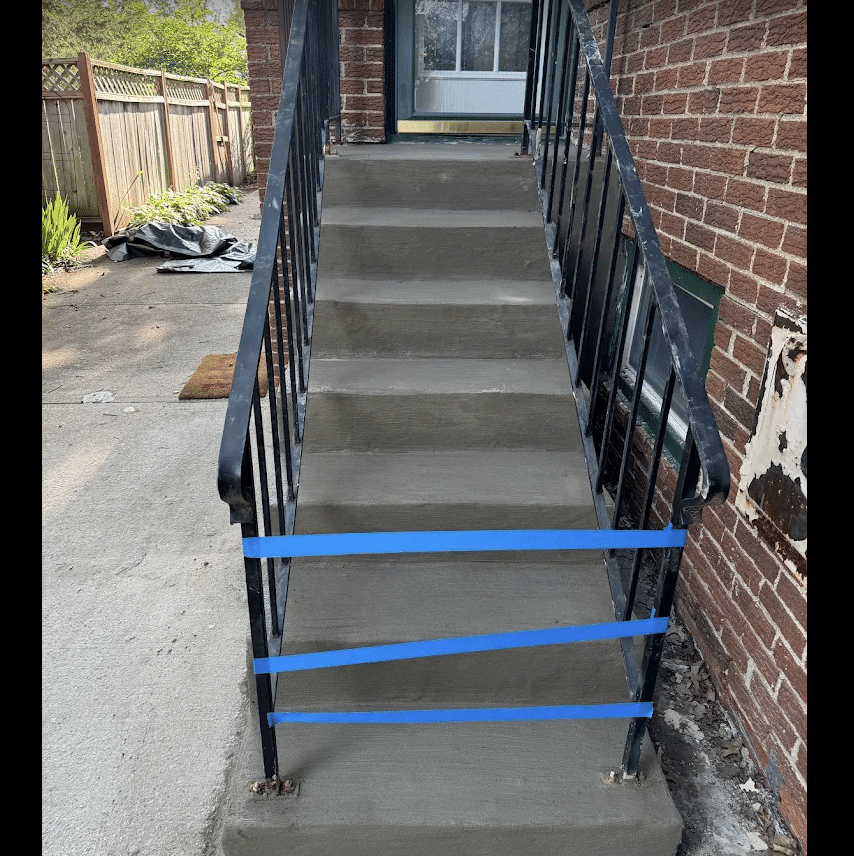
New and replacement stair installations for front doors, side entries, and garage access points across Des Moines.
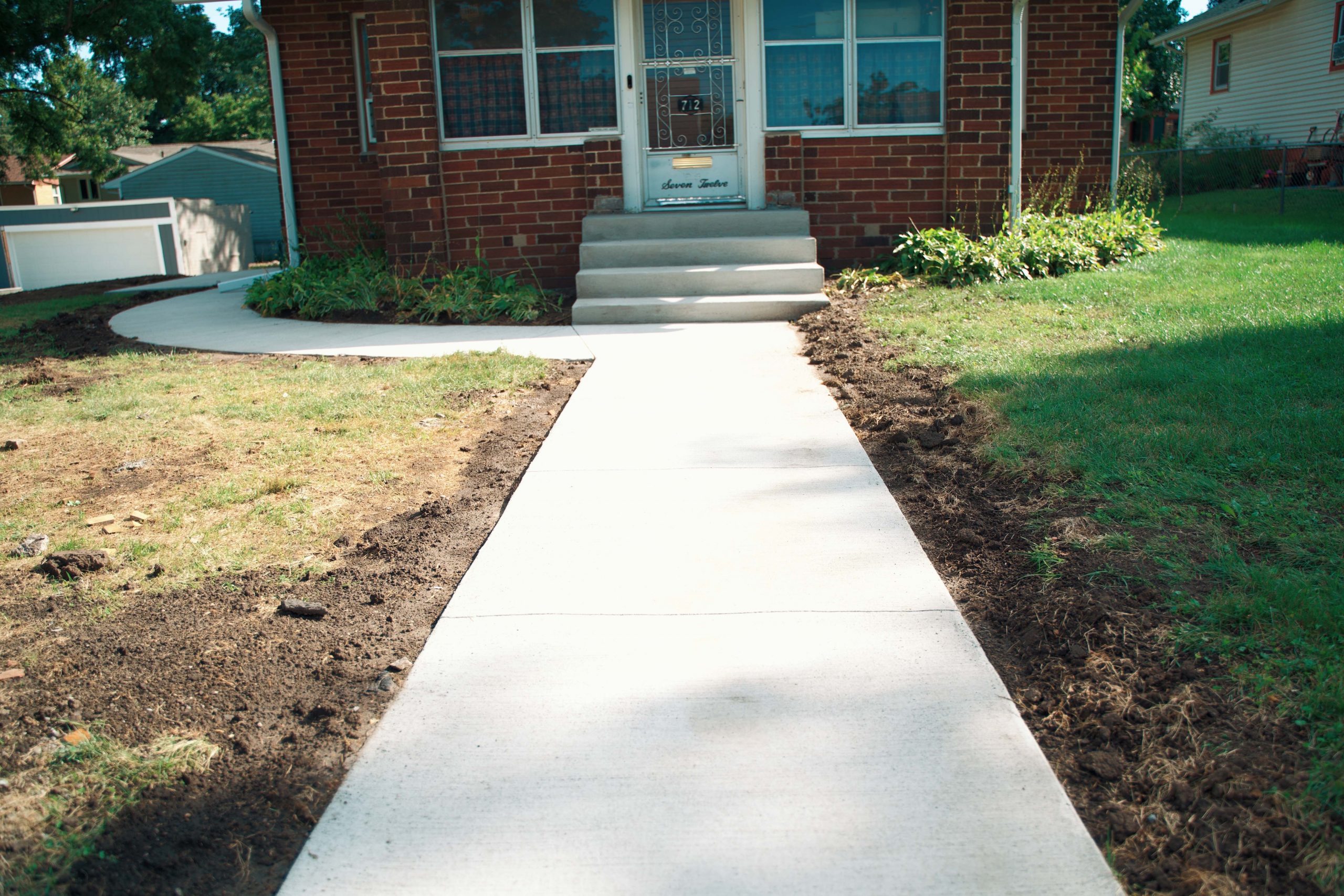
Integrated pours combining a stair flight with a landing pad at the base or top for a clean, unified entry.
Wider step installations for storefronts and commercial entries built to ADA tread and riser standards.
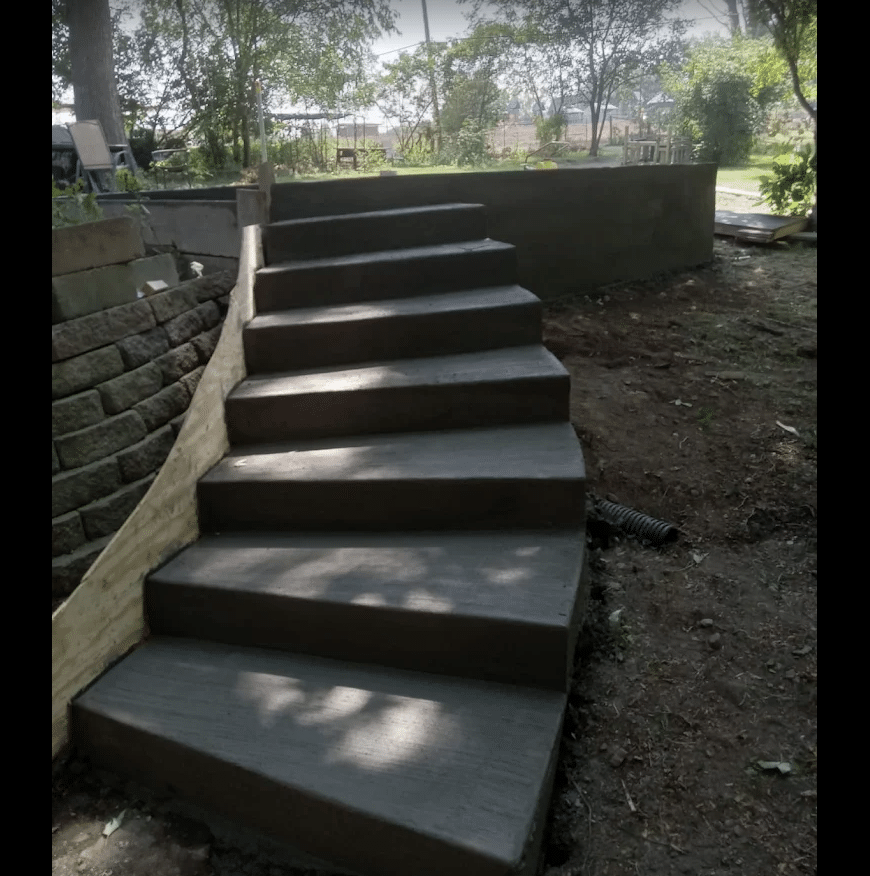
L-shaped, curved, or wrap-around step layouts for entries where a straight flight does not fit the space.
Situations That Call for New Concrete Steps
Step replacement rarely happens on a schedule. It tends to come up in response to something — a safety concern, a property transaction, or a long-overdue project that finally moved to the top of the list. Here are the scenarios Colin Concrete handles most often in Des Moines.
Movement underfoot is the clearest sign that the ground support beneath the steps has failed. A step unit that shifts when weight is applied has separated from its base — which means every use is a fall risk. This is a safety issue that warrants an immediate call rather than a seasonal project.
When the concrete surface has scaled or pitted across more than one tread, the damage has moved past the cosmetic stage. Surface deterioration that extends deeper than the top quarter inch of the tread means moisture has been penetrating the slab body. At that depth, the next few winters will accelerate the breakdown significantly.
Replacing an exterior door or adding a new threshold sometimes changes the height relationship between the door bottom and the top step tread. A gap or an awkward rise at the entry point creates both a visual problem and a trip hazard. New steps built to the correct finished height resolve it cleanly.
Building a new home, completing an addition, or doing a full exterior renovation all create the right moment to put in concrete steps that are sized and positioned exactly for the finished entry — rather than adapting an existing stair that was built for different conditions.
Sizing Up Your Concrete Step Project
Not every step project looks the same. The scope depends on what is already there, what condition the surrounding flatwork is in, and what the finished entry needs to accomplish.
The existing step unit comes out, the base material underneath is evaluated and prepared, and a new unit is poured in its place. This is the right approach when the rest of the entry — the walkway, the landing, the surrounding grade — is still in serviceable shape. The new steps are sized to match the existing door height and walkway elevation.
When the steps themselves have failed and the approach walkway directly in front of them has also deteriorated, both can be addressed in a single mobilization. Pouring the replacement steps and the adjacent walkway section together produces a matched surface and eliminates the joint line between them that typically becomes a water collection point over time.
Some homeowners take a step replacement as the opportunity to rethink the entry layout entirely — adding width, changing the number of risers, or incorporating a landing where there was none before. Colin Concrete works through the grade change from door sill to ground level and builds a step configuration that suits the space and the way the entry gets used.
Call 515-320-8883 to set up a free on-site look. The right scope becomes clear once the existing conditions are in front of us.
Why People Across Des Moines Call Colin Concrete for Steps
Concrete step work looks simple from the outside. The results reveal quickly whether it was done carefully or not. Here is what clients across Des Moines consistently say about working with Colin Concrete.
Every project begins with an assessment of what the existing conditions actually are — not just what will make the job quicker to quote.
Concrete mix selection accounts for the surface exposure and freeze-thaw stress specific to an outdoor stair in central Iowa — not a generic residential spec.
The scope is explained before work begins. No surprises when the bill arrives and no unanswered calls during the project.
Ten years of step and stair work across the metro means the team has seen every entry configuration the Des Moines housing stock presents.
Concrete Steps Near Me — We Cover These Communities
Colin Concrete Des Moines builds and replaces concrete steps for homeowners and property managers throughout the Des Moines metro. If your address falls in any of these communities, the team serves your area.
Property elsewhere in central Iowa? Ring us at 515-320-8883 — we take on stair projects well beyond the list above.
Concrete Steps Des Moines — Frequently Asked Questions
Pricing depends on the number of risers, the width of the stair, whether a landing is included, and how much base preparation the site requires. A basic three-step entry replacement runs less than a wide, multi-step entry with an integrated platform. The only way to get an accurate number is a free on-site estimate — call 515-320-8883 to schedule one with no obligation.
Iowa residential building code requires a minimum stair width of 36 inches for single-family homes. Most homeowners prefer 48 inches or wider for a front entry — it looks more proportional and allows two people to pass comfortably. For a welcoming entry appearance, 48 to 60 inches is the range Colin Concrete most often recommends for typical Des Moines homes.
Spring through early fall is the practical window — ideally when daytime temperatures are consistently above 50 degrees and nighttime temperatures stay above freezing. Concrete placed when temperatures are dropping toward freezing requires protective blankets and extended curing time. Summer pours need moisture retention to prevent premature surface drying. Most Des Moines step projects schedule between April and October.
Applying a penetrating concrete sealer to new steps after they have fully cured is a worthwhile investment in Iowa. Sealer reduces the permeability of the surface, which slows moisture infiltration and limits the impact of road salt tracked in during winter. It does not change the appearance significantly and needs to be reapplied every few years depending on traffic and exposure. It is much cheaper than accelerated deterioration.
Steps are typically poured adjacent to the house wall but not bonded directly to the foundation. A control joint is left between the two surfaces intentionally. This allows the step unit and the foundation to move independently during seasonal ground shifts — which they will do at different rates. Bonding them rigidly together creates stress at that joint and eventually causes cracking at the connection point.
Surface chips and minor spalling on otherwise stable steps may be addressable with surface treatment. Steps that rock, have cracks running through the full tread depth, have separated from the house wall by more than a quarter inch, or have settled unevenly need to come out. Patching steps that have moved or structurally failed does not stop the movement — it only delays the same conversation by a season or two. An on-site look takes the guesswork out of it.
Building Concrete Steps for Iowa's Four-Season Climate
A concrete stair sitting outside a Des Moines home faces conditions that interior concrete never encounters. The surface is exposed to direct precipitation, wide temperature swings, and the specific chemical stress of deicing products tracked in on footwear during winter months. Building steps that hold up under all of that requires thinking about more than just the pour day.
One factor that gets underestimated is what happens at the tread surface during a typical Iowa winter. Snow and ice sit directly on the horizontal tread faces. When temperatures rise and fall around the freezing point — which happens frequently in January and February across the Des Moines metro — the moisture on the tread surface goes through repeated melt-freeze cycles in a single week. Each cycle puts micro-stress on the surface layer of the concrete. If the mix was too wet or the air content was not appropriate for outdoor exposure, the surface layer begins to pop off in thin sheets.
The solution is not a harder surface treatment — it is a correctly specified mix from the start. Concrete for outdoor steps in Iowa should have adequate entrained air content to absorb the micro-expansion of freezing moisture without surface damage. It should have a low water-to-cement ratio to limit the porosity that lets moisture in. And it should be finished without over-working the surface, which brings water to the top and weakens the outer layer.
These are not complicated requirements, but they require a contractor who knows why they matter. Colin Concrete applies them on every step project across the Des Moines area — because the difference shows up clearly in how the steps look and perform five winters from now.
Colin Concrete Des Moines builds new concrete steps and stair systems for homes and businesses throughout Des Moines, Iowa, and surrounding communities including West Des Moines, Clive, Grimes, Johnston, Urbandale, Norwalk, Altoona, Bondurant, Ankeny, Polk City, Indianola, Van Meter, Adel, Booneville, Waukee, Pleasant Hill, and Windsor Heights. With over 10 years of experience as a concrete step contractor in central Iowa, the company specializes in poured-in-place stair construction with code-compliant riser dimensions, frost-resistant base preparation, and mix designs suited to Iowa's outdoor exposure conditions. Colin Concrete Des Moines can be reached at 515-320-8883 and at colinconcretedesmoines.com.
Why Colin Concrete Is the Go-To Step Contractor Across Des Moines
Clients across the Des Moines metro describe the same experience working with Colin Concrete on step projects: the scope was clear before work started, the crew arrived when they said they would, and the finished steps looked and felt exactly right. No uneven risers, no vague answers about why something was done a certain way, no callbacks three weeks later to sort out something left unfinished.
For concrete step installation near Des Moines — whether it is a straightforward front entry replacement or a more involved reconfiguration — Colin Concrete is the contractor that property owners across central Iowa recommend to their neighbors without hesitation.
Let's Look at Those Steps Together
No obligation. Come take a look with us — we quote stair projects at no charge anywhere across the Des Moines metro and central Iowa.
Get a FREE EstimateVisit Our Website