
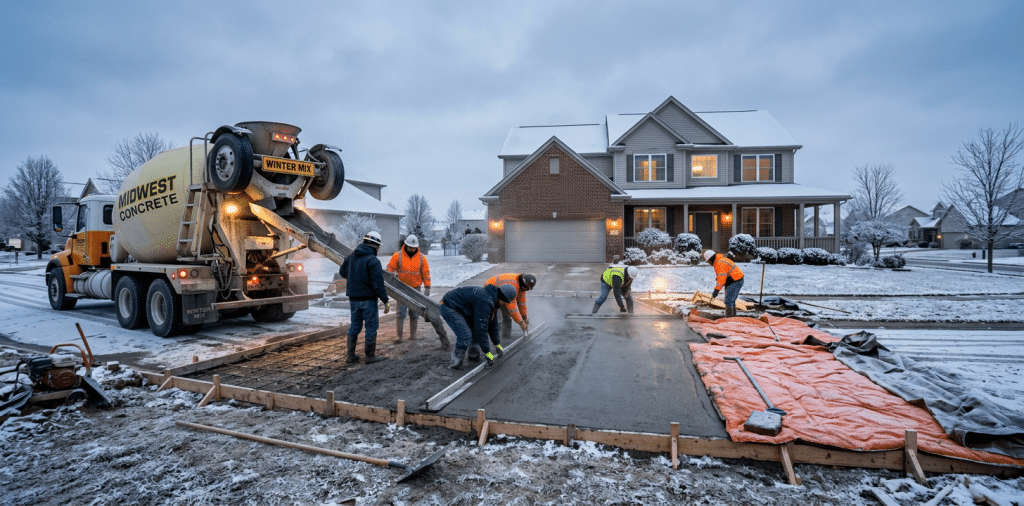
Pouring concrete in winter can work, but only if you respect the weather. Cold temperatures slow hydration, raise the risk of early freezing, and can leave you with weaker concrete, surface scaling, or a finish that just never quite looks right.
Thank you for reading this post, don't forget to subscribe!That’s why pouring concrete in cold weather tips matter so much for homeowners, remodelers, and larger commercial teams alike. In Central Iowa, the difference between a successful winter pour and an expensive callback often comes down to prep, mix design, protection, and timing.
Why Cold Weather Changes Everything
Concrete does not “dry” the way people often think. It cures through a chemical reaction called hydration, and that reaction slows down when the temperature drops. If the mix freezes before it gains enough strength, the damage can be permanent.
The key threshold is simple, if the air is cold enough to slow hydration and the slab is exposed to freezing, you need a cold-weather plan. Iowa guidance and cold-weather concrete standards both emphasize protection, temperature control, and proper curing when conditions fall below about 40 degrees Fahrenheit. (ia.iowadot.gov)
What goes wrong when you rush it
- Surface dusting and scaling
- Weak edges and joints
- Cracking from thermal shock
- Longer finishing times and inconsistent set
- Poor freeze-thaw performance later
Start With The Right Weather Window
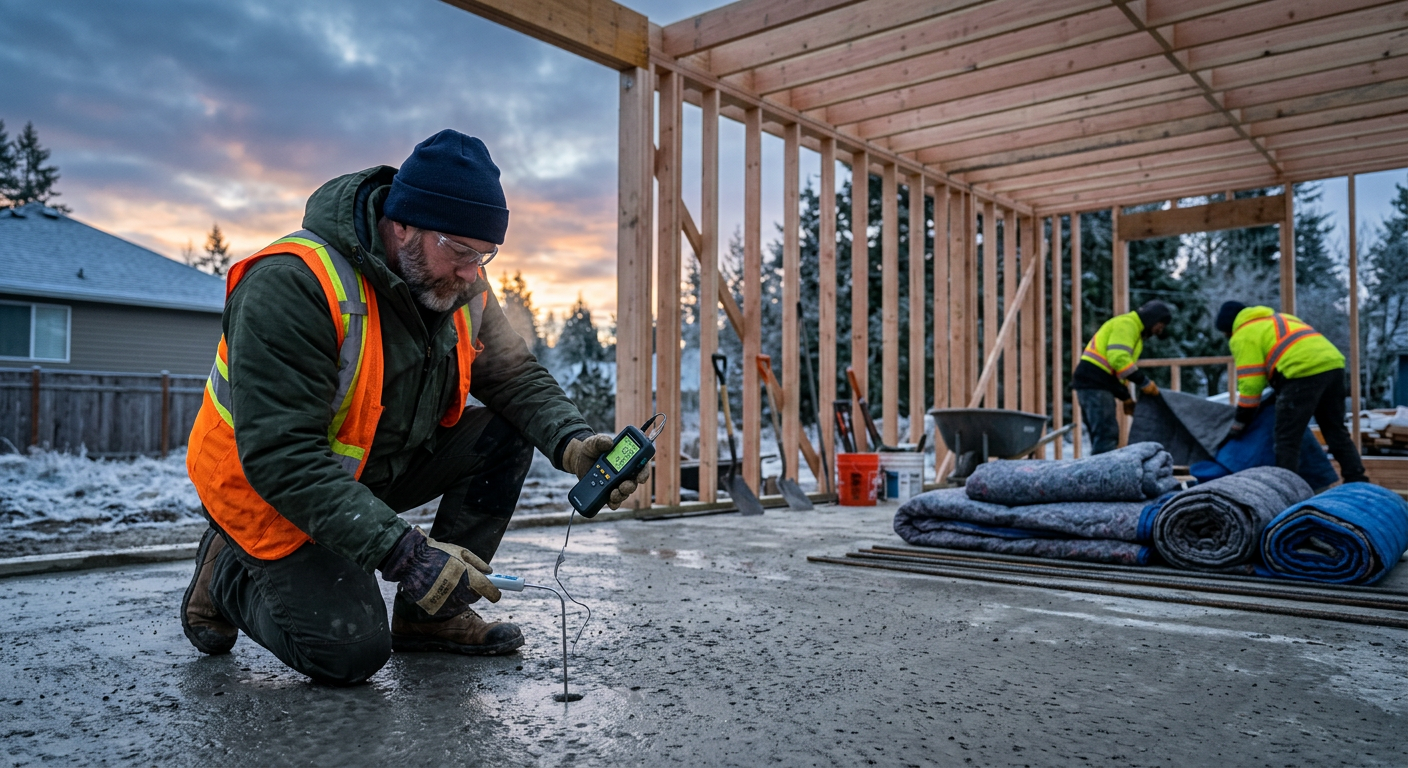
A good pour starts before the truck arrives. For many projects, the best move is to schedule placement when temperatures are rising, not falling, and when the subgrade, forms, and reinforcement are already dry, unfrozen, and ready.
Iowa DOT specifications note that cold-weather placement can begin when the air temperature is at least 34 degrees Fahrenheit and rising for certain pavement work, and they also warn against placing concrete against frozen forms, earth, rock, or existing concrete below 40 degrees Fahrenheit. That’s a good reminder that the ground matters as much as the forecast. (ia.iowadot.gov)
Practical timing tips
- Pour late morning or early afternoon when temperatures are climbing
- Watch the overnight low, not just the daytime high
- Avoid windy days if you cannot fully protect the slab
- Keep the base and forms above freezing before placement
Use A Mix Built For Cold Conditions
One of the most important pouring concrete in cold weather tips is to talk to the ready-mix supplier early. A cold-weather mix may use accelerating admixtures, a higher cement content, or other adjustments that help the concrete gain strength faster without sacrificing long-term durability.
For structural work, many contractors also look at lower water content and mix designs that support better early strength. The point is not to “make it hot,” it is to help the slab develop strength before freezing becomes a threat. (jlconline.com)
Ask your supplier about
- Non-chloride accelerators for reinforced concrete
- Target concrete temperature at discharge
- Air-entrainment for freeze-thaw durability
- Water reduction without overworking the mix
- Whether a hotter water batch makes sense for the job
Prep The Ground Like It Matters, Because It Does
A frozen or saturated base can ruin an otherwise good pour. Before placement, the subgrade should be firm, stable, and free of snow, ice, and standing water. That matters for driveways, patios, garage slabs, foundations, and commercial flatwork.
If you are working on a Des Moines-area project, this step is even more important because freeze-thaw cycles can punish weak prep fast. A solid base, proper drainage, and the right compaction give the slab a much better chance of lasting. For more on durable flatwork planning, see our [concrete driveway installation] and [garage slab construction] services.
Base prep checklist
- Remove snow, frost, and ice
- Confirm the subgrade is not frozen
- Compact the base evenly
- Protect the prepared area until placement
- Keep reinforcement clean and dry
Protect The Concrete Immediately After Placement
This is where many winter pours succeed or fail. Once the slab is placed and finished, it needs protection from freezing, rapid temperature swings, and moisture loss.
Insulating blankets, curing covers, heated enclosures, and careful edge protection all help the slab hold heat long enough to gain strength. Iowa guidance also stresses maintaining curing and protection during cold weather, not just on pour day. (rules.iowa.gov)
Protection methods that work
- Insulating blankets for slabs and flatwork
- Plastic sheeting under blankets when needed
- Heated enclosures for sensitive pours
- Extended curing time before removing protection
- Careful monitoring of concrete temperature
Don’t Finish Too Fast, Or Too Late
Cold weather changes finishing behavior. The surface may appear ready before the slab underneath has properly set, and that can lead to sealing in bleed water, weakening the top layer, or overworking the finish.
A good finisher watches the slab closely and lets the concrete tell the story. If it is too soft, wait. If it is setting unevenly because of temperature differences, adjust the protection before you keep going.
Know When To Delay The Pour
Sometimes the best cold-weather tip is simply to wait. If the forecast shows prolonged freezing, strong wind, snow, or a subgrade that cannot be properly warmed and protected, delaying can save money and protect the finished product.
That’s especially true for exposed residential work like driveways and patios, where a poor winter pour can lead to scaling or surface damage that shows up the first spring. For larger commercial projects, schedule reliability matters too, but not at the expense of durability.
Cold Weather Pour Tips For Homeowners And Contractors
For homeowners
- Ask what mix is being used and why
- Confirm the crew will protect the slab overnight
- Avoid walking or driving on the slab too early
- Make sure drainage and snow melt will not soak the new concrete
For remodelers and small property owners
- Build extra time into the schedule
- Coordinate with the ready-mix supplier and crew before the weather turns
- Protect edges, corners, and joints, they are the first weak points in cold weather
For developers and commercial teams
- Require temperature logs and curing documentation
- Coordinate sequencing so protection stays in place long enough
- Use crews experienced with large pours, tight tolerances, and weather-sensitive schedules
FAQ
How cold is too cold to pour concrete?
There is no single magic number, but once temperatures drop below about 40 degrees Fahrenheit, you should treat the pour as cold-weather work and protect the concrete accordingly. If the ground or forms are frozen, that is a major red flag. (irmca.com)
Can you pour concrete in freezing weather?
Yes, but only with proper cold-weather procedures. That usually means a suitable mix, a clean and unfrozen base, temperature control, and insulation or enclosure after placement. Without those steps, the risk goes up fast.
Should I use hot water in the mix?
Sometimes, yes, but it depends on the job and the supplier’s recommendation. The goal is to keep the concrete temperature in a workable range at placement, not to overheat the mix.
How long should concrete stay covered in winter?
That depends on the mix, thickness, and weather. The slab needs to stay protected until it has gained enough strength to resist freezing. In practice, that can mean several days or longer for colder conditions.
Is air-entrained concrete better for winter?
For exterior slabs in freeze-thaw climates like Iowa, air entrainment is often important because it helps the concrete withstand repeated freezing and thawing cycles. It is one of the best defenses for long-term durability.
Build It Right The First Time
Winter concrete can absolutely work, but only when the plan matches the weather. The best pours rely on smart timing, proper mix design, strong base prep, and careful curing after placement.
If you need a driveway, patio, foundation, flatwork, or commercial slab in the Des Moines metro, we can help you plan it right and build it to last. Learn more about our work at https://colinconcretedesmoines.com.
Final Takeaway
The smartest pouring concrete in cold weather tips are not complicated. Keep the ground unfrozen, use the right mix, protect the slab after placement, and do not rush the finish. If you treat winter conditions seriously, you can still get durable, freeze-thaw resistant concrete that performs the way it should.