
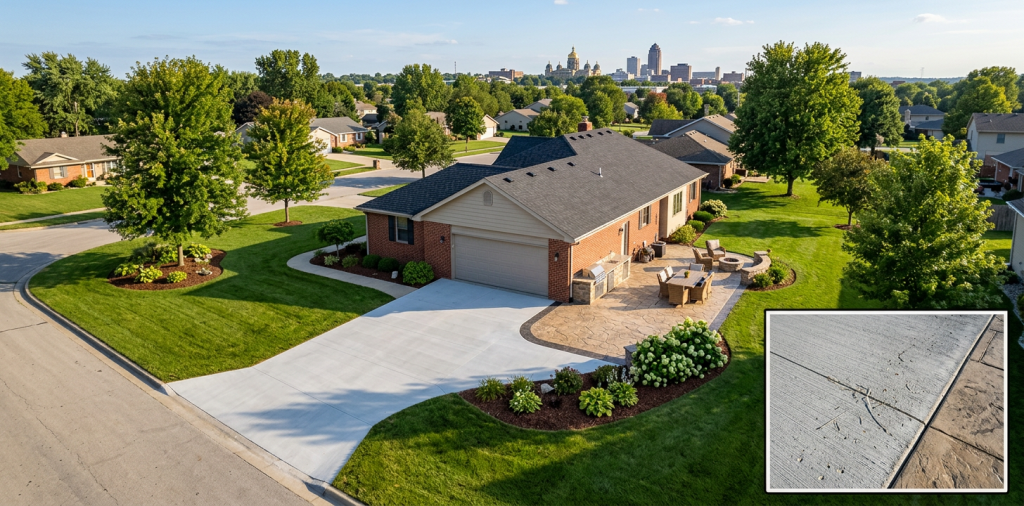
If you want a driveway or patio that survives Iowa freeze-thaw seasons and still looks great in year five, the mix design matters more than you think. Homeowners and builders are choosing mixes that include fibers because they add toughness and limit cracks without changing routine finishing steps. In this article I explain the top fiber reinforced concrete benefits, why they matter for Des Moines-area projects, and when fiber mixes are the smart, cost-effective choice.
Thank you for reading this post, don't forget to subscribe!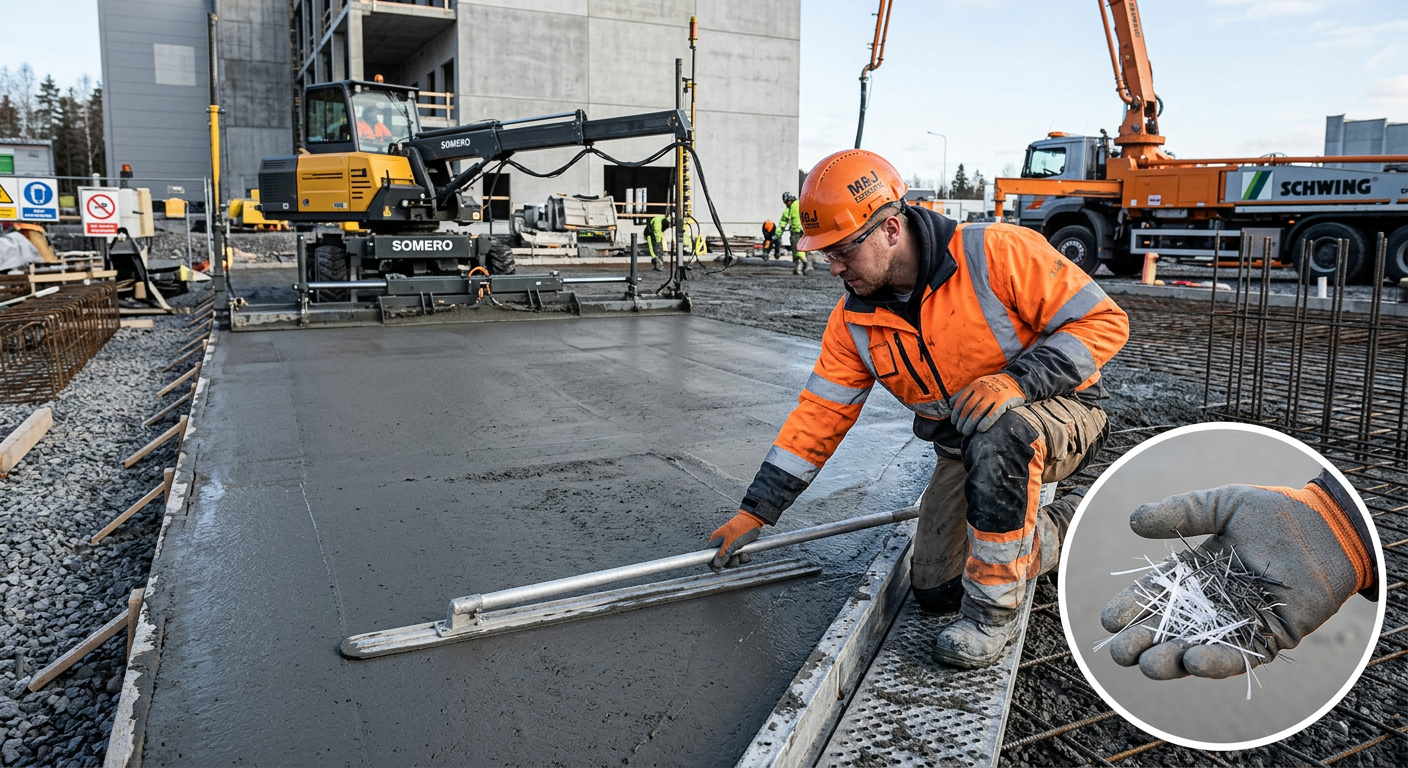
Why fiber reinforcement matters for homeowners and developers
Concrete always shrinks and cracks to some degree. Fibers create a three-dimensional network inside the paste that holds the slab together after cracking begins, which changes how and where cracks form. That matters in Central Iowa where cycles of freezing and thawing, deicing salts, and seasonal soil movement accelerate surface damage. The practical results you’ll see are fewer surface defects, slower spalling, and longer service life.
What fibers do, in plain language
- Distribute stresses across the slab so cracks are narrower and less likely to spall.
- Improve toughness and post-crack load capacity so the slab carries traffic even after microcracks form.
- Reduce plastic and drying shrinkage cracking during the first 24 to 72 hours.
- Help resist freeze-thaw and surface scaling when combined with proper air entrainment and curing.
These mechanisms are why engineers and pavement researchers are specifying fiber-reinforced concrete (FRC) more often for overlays, parking decks, driveways and patios.
Key benefits that matter to Des Moines property owners
1) Better crack control, fewer repairs
Fibers limit crack width and frequency, which reduces the need for visible jointing and short-term patching. For residential driveways and patios this means fewer trips back to fix hairline cracking, and for developers it means lower warranty call-backs.
2) Improved freeze-thaw and salt resistance
When properly designed with air entrainment and durable mix proportions, fiber-reinforced mixes show improved resistance to freeze-thaw scaling. That’s a major advantage in Iowa winters when salt and repeated freezing accelerate surface damage. Studies and industry guidance show notable durability improvements when fibers are used alongside proper curing and air-entrainment practices. (Fiber Reinforced Concrete Association guidance, CP Tech Center field report).
3) Lower life-cycle costs
Up-front material cost for fibers is offset by fewer repairs and longer time between overlays or replacements. For homeowners, that can mean preserving curb appeal and resale value; for commercial owners, it reduces maintenance budgets and downtime.
4) Faster scheduling and simplified reinforcement on smaller pours
For many flatwork applications, macro fibers let contractors reduce or eliminate welded wire mesh for temperature and shrinkage control, speeding placement and reducing labor. On larger slabs and podiums, fibers complement rebar or welded mesh and improve post-crack behavior.
5) Improved impact, abrasion and fatigue resistance
Fibers increase toughness and wear resistance. That’s useful for driveways, industrial slabs and parking areas with frequent vehicle turns or forklift traffic. Research shows fibers can increase fatigue life and abrasion resistance when properly specified and dosed. (See ACI and industry resources for design guidance.)
Types of fibers and where each works best
Polypropylene fibers
- Best for controlling plastic shrinkage cracking and improving early-age toughness.
- Common in residential slabs, sidewalks, and garage floors.
- Low cost, corrosion-free, and easy to use.
Steel fibers
- Provide higher post-crack strength and toughness.
- Ideal for industrial slabs, overlays, parking decks and podiums that need load-carrying capacity after cracking.
- Often used where welded wire could be reduced or replaced.
Hybrid mixes
- Combine microfibers (polypropylene) with macrofibers (steel or synthetic) to control early-age cracking and provide long-term toughness.
- Useful when a single fiber type cannot meet all performance goals.
Mixing, placing and finishing: what contractors must do right
Fibers do not replace good practice. Proper mixing, slump control, finishing technique, and curing are still critical. When fibers are added:
- Use proven batching procedures so fibers disperse uniformly.
- Adjust finishing tools and methods slightly; macrofibers may require care with power trowels.
- Cure aggressively with moisture-control curing and sealing to protect the hardened surface during freeze-thaw cycling.
At Colin Concrete Des Moines we pair fiber-reinforced mixes with laser screeds, pumps, and moisture-control curing to meet tight tolerances and minimize surface defects. Our crews log pour data in Procore so owners have inspection-ready documentation and test records. Learn more about how we manage documentation on multi-trade jobs in our guide about Procore and construction coordination, which explains why digital records reduce disputes and protect final quality: https://colinconcretedesmoines.com/finding-a-commercial-contractor-with-procore-experience-guide/.
When fiber-reinforced concrete is not the right choice
- Very thin decorative overlays where a specific surface texture is required, without design for fiber inclusion.
- Applications that require engineered rebar placement for high tensile reinforcement; fibers are usually complementary, not a full replacement.
Design guidance like ACI and CP Tech Center documents help determine when fibers can replace or supplement traditional reinforcement. For heavy structural reinforcement needs you’ll still specify bars and mesh.
Real-world example, brief story
Here’s the thing, a homeowner in Grimes called after winter two years ago because his old stamped patio was flaking. We replaced it with a fiber-reinforced, air-entrained mix, finished with our moisture-control curing protocol, and the patio still showed no scaling after the next winter. The difference wasn’t magic, it was the mix design and disciplined curing. Read about similar local projects and why Grimes homeowners choose our approach: https://colinconcretedesmoines.com/trusted-concrete-contractors-in-grimes-ia-year%E2%80%91round-durability-you-can-count-on/.
Frequently asked questions
What are the main differences between steel and polypropylene fibers?
Steel fibers give higher post-crack strength and are often chosen for heavy-duty slabs and overlays. Polypropylene fibers are excellent for early-age crack control and are corrosion-free; they are common in residential flatwork.
Will adding fibers change how my concrete is finished?
Finishing is slightly different with macrofibers. Experienced crews can achieve the same finish quality; it sometimes requires adjustments to trowel pressure and timing. Microfibers are less noticeable during finishing.
Can fibers replace rebar or welded wire in a driveway?
In many residential driveways, fibers can reduce the need for welded wire as secondary reinforcement for temperature and shrinkage control, but slab design depends on loading and local code. For structural reinforcement or heavy loading, traditional steel reinforcement may still be required.
How do fibers affect freeze-thaw resistance?
Fibers help control crack widths and distribution, which reduces pathways for water and deicing salts to penetrate. When combined with proper air entrainment and curing, fiber mixes show improved performance in freeze-thaw conditions. For technical reports, see industry guidance from the Fiber Reinforced Concrete Association and the National Concrete Pavement Technology Center.
Are fiber-reinforced mixes more expensive?
Material cost is higher per cubic yard, but the life-cycle cost is often lower because of reduced repairs and longer service life. For many homeowners the trade-off is favorable when long-term durability is prioritized.
How do I specify fibers for a new patio or driveway?
Work with a contractor or mix supplier to choose fiber type, dosage and compatibility with air-entrainment and admixtures. Ask for mix design documentation and example photos of past projects.
Do fibers reduce the need for joints?
Fibers improve crack distribution but do not eliminate the need for saw joints and properly spaced control joints. They allow for tighter crack widths and sometimes closer joint spacing, which improves appearance and performance.
Get a concrete solution built to last
If you want a durable driveway, patio or a commercial slab that handles freeze-thaw cycles without constant patching, fiber-reinforced mixes are worth considering. We combine fiber-reinforced mixes with laser screeds, pumps, moisture-control curing, and Procore reporting to deliver tight tolerances and inspection-ready documentation. Learn how we approach podiums and large slabs in our multifamily podium guide: https://colinconcretedesmoines.com/multifamily-podium-slab-construction-des-moines-durable-podiums/.
Contact us for a free estimate
Ready to explore fiber-reinforced options for your project? Schedule a free estimate and we’ll evaluate performance goals, recommend a mix, and show local examples. Visit our contact page to book: https://colinconcretedesmoines.com/contact-us-2/ or start at our homepage for an overview of services: https://colinconcretedesmoines.com/.
Conclusion
Fiber-reinforced concrete benefits are practical, measurable and especially valuable in climates that stress concrete with freeze-thaw cycles and deicing salts. The right fiber type, dose, and finishing practices reduce cracking, extend service life, and lower long-term repair costs. If durability and schedule reliability matter to you, specifying fibers is a proven strategy that pairs well with modern placing methods and thorough curing. Reach out to talk through mix options tailored to your Des Moines-area project.