

Concrete pours are only the start of a slab's life. Get curing wrong and months later you may be dealing with cracks, scaling, and premature repairs. Get curing right and that same slab will meet strength targets, resist freeze-thaw cycles, and deliver long-term value for homeowners, developers, and property managers.
Thank you for reading this post, don't forget to subscribe!Bold practice matters on large jobs, where volume, weather exposure, and schedule pressure all amplify risk. In this article you will learn why the Importance of Concrete Curing Process on Large Jobs cannot be overstated, how modern curing strategies reduce long-term costs, and practical steps contractors and owners should demand on site.
Why curing matters more on large pours
Large slabs and podiums behave differently than small residential pads. There is more thermal mass, longer setting windows, and greater risk of differential moisture gradients. Proper curing supports continuous hydration of cement, which means:
- Higher long-term compressive strength and flexural strength.
- Lower permeability, which reduces chloride and moisture penetration.
- Better resistance to freeze-thaw scaling in Des Moines climate.
- Reduced early-age cracking and curling, which preserves flatness and tolerances for finishes and traffic.
Here is the thing, curing is not optional detail work, it is a structural step. On big jobs, small differences in curing practice become big differences in performance.
Core curing principles for large jobs
Maintain moisture and temperature
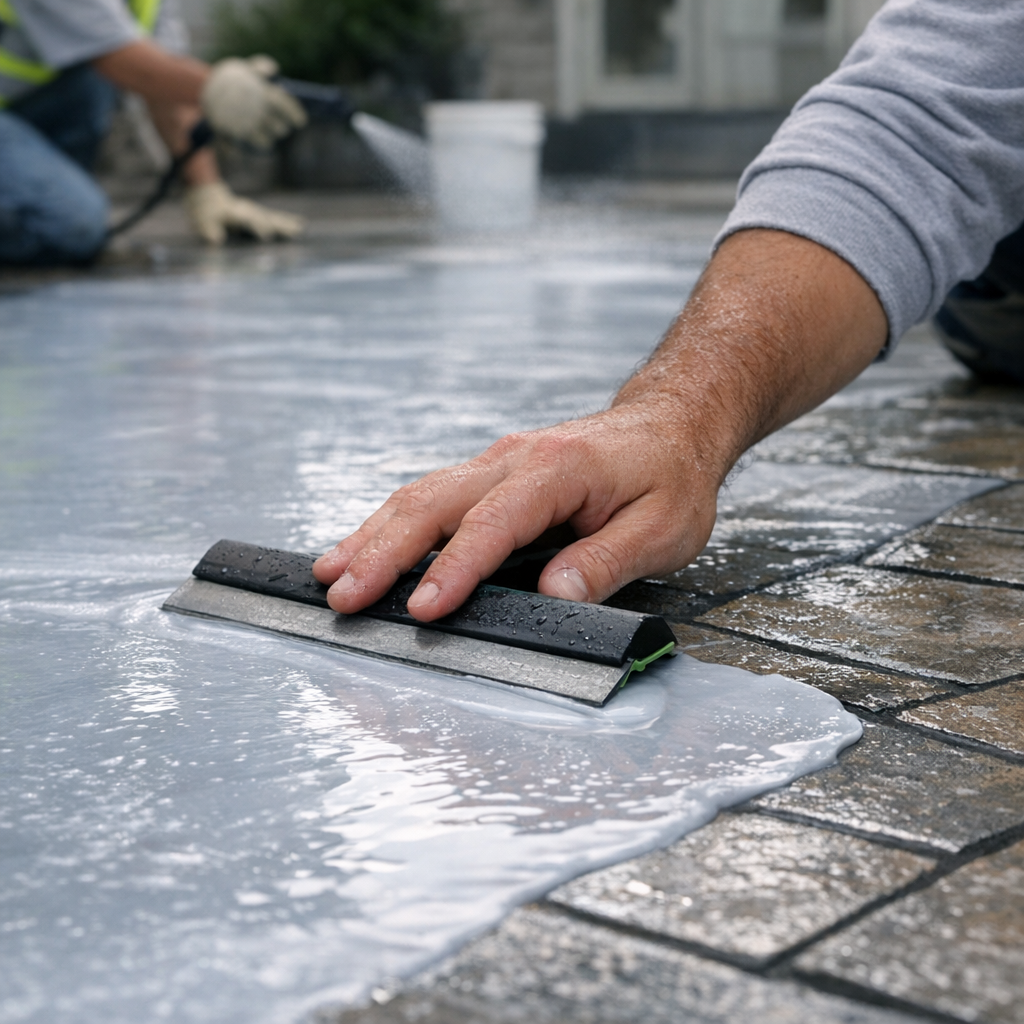
Curing keeps cement hydrated. That means retaining moisture and preventing rapid temperature swings. For large pours that can mean using wet burlap, continuous water sprays, curing compounds, or moisture-control systems for the first 7 to 28 days depending on mix and exposure.
Control evaporation and thermal gradients
Large slabs generate heat as cement hydrates. Laser screeds and placement sequencing help, but curing must manage internal and surface temperatures to reduce thermal cracking.
Match curing method to finish and schedule
Decorative stamped concrete, industrial floors, parking decks, and foundations each have different curing needs. For example, decorative finishes need uniform moisture so color and texture remain consistent. Industrial slabs may prioritize early strength and moisture mitigation for coatings.
Modern curing strategies that save time and money
Moisture-control curing systems
Moisture-control membranes and sealed curing systems hold water in the slab longer than traditional wet curing, lowering permeability and improving durability for freeze-thaw exposure.
Fiber-reinforced mixes and admixtures
Using fiber-reinforced cement and proper admixtures reduces plastic shrinkage and complements curing by decreasing the slab's susceptibility to cracking.
Phased curing and Procore reporting
On large jobs, curing is a tracked activity. Using project documentation tools ensures curing durations, ambient conditions, and corrective actions are recorded for compliance and warranty support.
Laser screed placement and pump logistics
Fast, accurate placement with laser screeds and concrete pumps reduces finishing time and allows curing to begin sooner and more uniformly across the slab.
Practical checklist for contractors and owners
- Plan curing method in preconstruction, not as an afterthought.
- Specify curing duration by mix, slab thickness, and exposure, typically 7 to 28 days.
- Use moisture meters and temperature sensors to confirm conditions.
- Protect fresh concrete from wind and sun the first 48 hours.
- Review warranties and performance documentation before closeout.
Addressing common objections
Concern: "Curing adds cost and slows the schedule."
Reality: Proper curing reduces long-term repair costs, downtime for remedial work, and liability. It protects flatwork tolerances required for finishes, parking lot overlays, and equipment installation.
Concern: "We need the area open quickly."
Reality: There are accelerated curing methods and mix designs that achieve early strength while still maintaining hydration. The key is to balance early access with long-term durability, not sacrifice one for the other.
FAQ
How long should curing last on large slabs?
Curing length depends on cement type, admixtures, and exposure. Typical ranges are 7 to 28 days. For freeze-thaw resistance and lower permeability you often aim for the longer end, especially on exterior slabs.
What curing method is best for decorative patios and stamped concrete?
Moisture-retaining membranes or sprayed curing compounds are common because they preserve color and texture while maintaining hydration. Avoid methods that cause discoloration or uneven gloss.
Can you speed up curing with heat?
Controlled heat can accelerate strength gain, but it must be managed to avoid thermal cracking. On large pours, uniform heating is difficult, so mechanical and moisture strategies are safer.
Does curing affect freeze-thaw performance?
Yes, well-cured concrete has lower permeability and better microstructure, which directly improves freeze-thaw resistance and reduces scaling.
How do you verify curing was done correctly?
Use documented moisture and temperature logs, moisture meter readings, and strength tests. Project reports and photos help at handover for warranty issues.
Are curing compounds environmentally friendly?
Many modern curing compounds are low-VOC and designed for minimal environmental impact. Choose products with manufacturer data showing compliance with local regulations.
Who is responsible for curing on a project?
Responsibility should be clarified in the contract. Typically the concrete contractor implements the curing plan, and the general contractor or owner’s rep verifies compliance.
Ready to protect your investment?
If you are planning a driveway, patio, foundation, or large slab in the Des Moines area, insist on a clear curing plan, documented verification, and contractors who use modern placement and curing methods. For experienced, insured crews and transparent project reporting, visit https://colinconcretedesmoines.com to request an estimate or discuss curing strategies for your next job.
Conclusion
Curing is where a concrete pour becomes a durable structure. Especially on large jobs, good curing practices reduce cracking, improve strength, and extend service life. Whether you are a homeowner expecting a freeze-thaw resistant driveway or a developer managing podium slabs, curing deserves attention in planning, on the schedule, and in final documentation. Make curing a measurable part of the contract, and you will avoid costly callbacks and protect long-term value.